Guest Post: Colin Munson – “Challenging Challenges for Thinking People”

My friend and fellow designer Colin Munson asked if he could write a guest post for my blog, and my answer was “HELLS YEAH!” Colin and I worked together for 5 years at Insomniac, and he’s one of my favorite Game Designers in the industry. I found the following editorial fascinating, and I’m proud to post it here. I hope you enjoy it as much as I did!

The Adventure game for the 21st century
or
why we get stupid while playing modern video games
or
Challenging challenges for thinking people

By Colin Munson:

This article began as an attempt at a design doc intended to capture the joy of an adventure game but update the mechanic to be palatable to the average gamer. In short, design an old school adventure game for the 21st century.

There were 4 things I wanted to accomplish with the design:

1)     Players must interact with the world in a similar way to old-school adventure games

  • very simple, easily accessible interface (basically, point and click)

2)     The adventure elements needed to work well with a full 3d environment

  • this was an added challenge to see if it could be done

3)     Include an action-game element that work seamlessly with adventure game elements

  • this is a conceit on my part. I had a hunch that traditional adventure games were far too slow paced for modern gamers.

And most importantly:

4)    Make players think

  • Why? Because, while playing a modern action game, players do not read, listen, or express the linear rational thought that we’ve all worked so hard to evolve and refine over the last billion years of evolution. We’ll talk about this phenomenon a little later.

I began by identifying what I loved about adventure games. This would be the basis for my design and help me begin to form a picture of what the final game design might look like. The list was quite interesting :

Adventure game pros:

Complex story, charming characters, possibility for humor (my own taste, not at all required), good puzzles that made me think, a wide variety of unique interactive objects, a huge variety in locales, and an equally huge variety of challenges.

And then I came up with the list of features that I didn’t like about adventure games:

Adventure game cons:

Frequent ambiguous puzzles with only one solution; Slow paced; Often a complete absence of understanding of the game rules -like what is interactive and what isn’t; extremely limited game world (usually a 2d world); fundamental lack of creative problem solving for the player (see item 1).

So, I’ll use the Pros list as a simple jumping off point for my design, and I’ll try to solve all of the problems in the Cons list that are inherent in adventure games. Easy, right? But how do I solve all of these problems? As a designer I thought these lists were pretty interesting, because, if I was to identify what I loved about modern action games (say, a first person shooter), it would look like this:

FPS pros:

High action (fast paced), clear goals (simple “story”), sense of power and success (basically, non-intellectual rewards), sense of mastery over the world and over my game tools like guns and grenades and level layout (intuitive game mechanics; simple, reusable rules), challenging scenarios that tested my reflexes, challenged my ability to parse friend from foe, and my ability to choose the right tool for the job (multiple, creative solutions to challenges).

Basically, the opposite of an adventure game… “Is that right?” I asked myself.  Was it really the opposite, or just the other half of what games can offer? Are they exclusive? Can they be combined?

As I tried to identify the similarities between the two genres, I kept coming back to the same single problem that effected both genres in different ways. This fundamental design flaw in both genres was so deep that I couldn’t really picture a video game without it, yet it blocked my ability to blend these two beloved genres.  This problem wasn’t an easy one to solve, because if it were solved, then video game challenges would have to take on a totally new form, so, like any respectable designer, I ignored it, and continued on my merry way.

So, now I had my 4 goals for the design, the fundamental problem that plagued the video game industry had been properly ignored, I had my list of challenges to solve (Adventure game cons list) and examples of the solutions (FPS pros list). I was ready to begin.

So, I began designing. It was magic. I was writing documents, creating metrics, ignoring problems, and creating new genres. Life was good -blissful, in fact. However, when it came down to folding the adventure game elements in with the action elements… Godamnit! Who would have guessed I would have run into fundamental design problems! I was ignoring those, damnit! How dare they come back and bite me?!

Here’s the problem I tried so hard to ignore:

Most games make a seemingly  easy, mundane task…

…brutally difficult

FPSs, 3PSs, and adventure games, in particular, make extremely simple activities like looking up and down, pointing a gun, turning around to respond to a noise or sound, or (from an adventure game) picking up a fish – hard, sometimes extremely hard.

Here’s what I mean…

If any of you, out there in the internet, have ever turned your head in response to someone calling your name, you have encountered the problem that I am talking about. The simple action of turning your head in response to outside stimuli is so automatic and effortless that it does not even register on your conscious awareness. In fact, in the 0.53 seconds it took to turn your head, you have likely already identified the speaker based on their voice, you have narrowed down a very short mental list of things that they are likely to want to talk with you about. You may even have responses queued up for each item on the list. You would then be free, for the remaining 0.11 seconds of your heads journey to the right, to begin to think about what you are going to have for lunch that day.

It took no conscious effort to move your head, you did not have to worry about over/under shooting your target, you did not worry that they have moved in that fraction of a second, you did it effortlessly and unconsciously which allowed you to do vast amounts of mental activity.

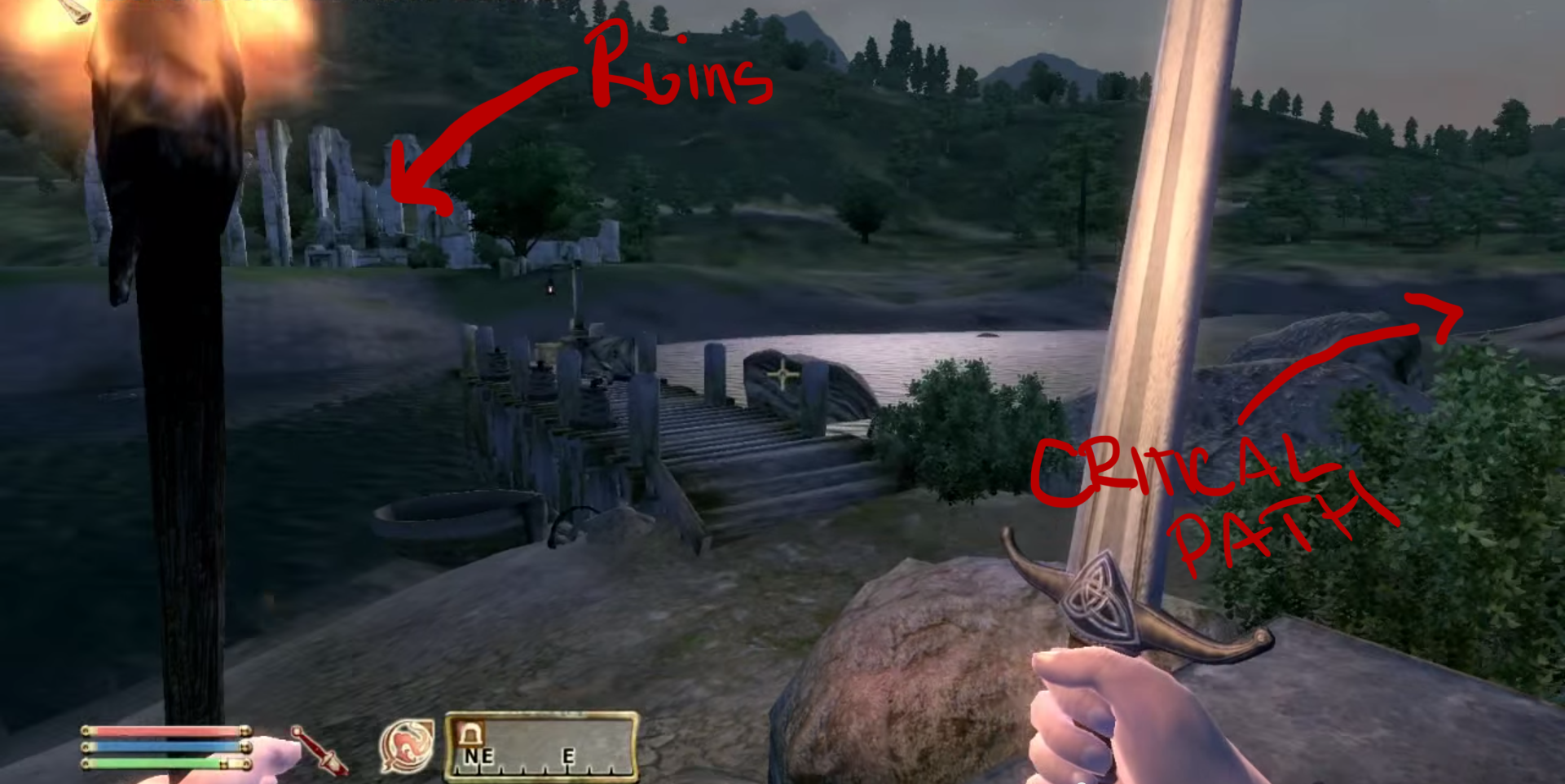
In an action game, this is not the case. Trivial mundane things, like turning around, looking for the source of a sound, or seeing movement out of the corner of one’s eye, is either impossible, or very difficult. AND these actions are the core for many video game genres. So, there is no room for mental activity if your sole focus is turning the controller to the 3 o’clock position for 0.16 seconds in order to rotate your view 39 degrees to the right.

We’ve given the player an exceedingly complex input mechanism (16 button console controller) and for the most part, made it mimic human movement, instead of human action.  So, players have to relearn how to MOVE THEIR HEAD with these primitive input mechanisms.

This forces players into a semi conscious state, because simple things like mobility and motor control, once as simple as turning their head to respond to a sound, are now relatively difficult, and without surround sound and a thorough understanding of the game world,  sometimes very difficult. This is why, in focus tests for action games, people don’t read help messages, don’t turn left if the right passage is blocked off, or don’t look around a room -even if they know an enemy is near.

So, what do we do? Well, there are many ways to solve the problem, but it really takes balls. It means killing a lot of notions about what players want from games, and what we, as designers, provide for challenges. If it was as easy in real life to turn towards a sound and pull a trigger, then your challenge in the game needs to be more complex than that. On one hand that is the most exciting thing that I can imagine in the industry, on the other hand it’s the most frightening thing I’ve ever heard.

The way to solve the problem is to identify the actions that take an unnecessary amount of effort to pull off (like responding to a noise that occurred  behind the player) and make them easy.  How? Well, work it out. It’s possible, I promise, I’ve seen it happen. It raises the player’s consciousness from lizard to human, with the full range of human thought and problem solving ability. It opens up a whole new approach to game design that is both super exhilarating and totally frightening (from a development perspective). Imagine if everything in video games were either as easy or easier to do than in real life? What challenges would you give to the player?

Autoconscious
Intentio-unconscious [in-ten-tee-o-un-kon-shuhs]
Adj. Put conscious effort into activities that would normally be unconscious

Idea: Dynamic Easy Mode

I had an idea that I’d like to explore some more when I get some free time.

I’ve noticed a trend lately in games’ easy modes (I tend to always play games on easy mode. I’m so hardcore it hurts sometimes) where, in addition to making it easier to avoid death, the game has made it easier to interact with the “cool things” about the game.

For example, in Bayonetta, the game was structured to take best advantage of her awesome (sexy) attack animations. In medium and up, in order to get all the coolest animations you have to perform combos with complex button orders and timings. When you play in easy mode, they make it so that whenever you fail to perform a specific combo (say you hit the wrong button or missed the timing window) the game randomly chooses and performs one for you. The end result of this is that even the players playing on easy get to see the coolest stuff your game has to offer.

In Uncharted 2, if you select easy mode they have an auto-lock-on feature like the one in the recent Call of Duty games. You press the “aim” button while your cursor is near a guy and you will snap to point directly at them. Unlike the Call of Duty system, though, more often than not this system ends with you point the gun at your enemy’s head (or very near to it). This meant that, while playing on easy, I got to run around and pop people in the head whilst feeling like a total badass. Essentially, they took the coolest part of the combat (popping people in the head) and made it so that people on the easy difficulty could access it relatively simply.

It’s an interesting trend. Historically, you do difficulty tuning by changing HP or Damage, or by adjusting how many enemies come at you, or any number of other ways. But all of those ways are structured around making it harder for you to die. The new generation of easy modes seem structured, as I mentioned, around making it easy for you to be AWESOME. It’s a small, but very meaningful difference.

So I got to thinking and brainstorming, and I think there’s a lot you could do with this idea as a dynamic system. Essentially, you could make a system that tracks how the player’s doing and adjusts the game according.

The Left 4 Dead games used such a system very successfully for managing difficulty across its levels. They control enemy spawns and enemy density dynamically (as well as, I suspect, HP and damage) to make the player feel a certain way at certain points in the level.

So, assuming you had a system like this, what kinds of “auto-AWESOME” things could you do to the player when you detect he needs it most?:

  • Give the enemies randomized deaths that range from “falling over” to “FUCKING EXPLODING” in terms of their theatrical impact. When you detect the player needs it (the player is in a slump, or is on a roll) you can change the random chances so that they get deaths near the FUCKING EXPLODING end of the spectrum more often.
  • Tune the music. If you had multiple tracks going at the same time, you could add or subtract elements to the music to change how the player feels about what he’s doing. If he’s having a hard time, play adrenaline music to pump him the fuck up! If he’s doing really well, play some EPIC music to make him feel even better. Etc…
  • Tune the weapon spawns. If he’s slumping, you can spawn weapons that result in grizzlier fates for the zombies, or which feel cooler.
  • If the player is on a roll and killing tons of zombies, spawn a ton of low-HP zombies nearby for him to mow through. If he’s slumping, maybe you do something similar but make them slow-moving less threatening low-hp zombies. Just a little “pick-me-up” from the game to you.
  • If you’re making a game like Diablo, perhaps you can increase the chance the player has of getting critical hits when they’re slumping. Or if you detect they’re at a high or low point you can circumvent the loot tables and spawn them something really neat to feel good about.

A lot of this is about theatrics over difficulty tuning, but I think the two can play well together. If your players are at a high point, let them live it up! If they’re in a slump, give them a little pick-me-up.

It’s something I’d like to explore some time. It’s certainly not right for every game, but it’s worth putting some brain-power to.

Woohoo! I wrote an article!

The industry website gamasutra.com has published an article of mine! It’s on the troubleshooting techniques I use when I find a game mechanic I’ve designed isn’t coming out deep enough:

http://www.gamasutra.com/view/feature/5901/evaluating_game_mechanics_for_depth.php

Check it out and let me know what you think!

Idea: Using Movie Structure to Inform Game Design?

I’ve been reading a lot about storytelling recently. Besides rereading “Characters and Viewpoint” by Orson Scott Card, the most recent ones I’ve read have been the “Save the Cat” books, by Blake Snyder (great reads, if you’re at all interested in screenwriting).

Snyder proposes a very analytical breakdown of the plots in movies. He has a list of 15 beats that appear in all popular movies (and they do… it’s almost scary) as well as a list of unconventional “genres” — essentially the different types of stories that movies tell. Within each genre, he further breaks down common elements and pieces of structure shared by all the best of them.

For example, one of the genres is “Monster in the House.” Essentially, this is the type of  movie like Aliens, Jaws, or Fatal Attraction. Films that fall into the Monster in the House genre have, according to Snyder: A “monster” (the Aliens, Jaws, or Glenn Close), a “house” (a remote colony, a small town, or a family unit), and a “sin” that is committed (greed, more greed, or adultery).

The reason I’m reading these things, like pretty much everything I do, is to see what I can relate back to games. While reading Snyder’s books, it occurred to me that perhaps his breakdowns can be turned into a game in themselves.

Continue reading »

A Pen-And-Paper RPG Meta-System

My gaming group is quite odd, as it turns out. It’s HUGE. When we get everyone, we have 11-13 people.

This is great, but most games are made for 4-8 people. They tend to bog down when you get up above 8, and most pen-and-paper RPG designers aren’t trying to solve the problem of having too many players. This is most likely because the most common situation is the opposite — you have too few players.

Our large games tend to fall apart for a few reasons:

  1. The game’s rules, which run quickly with 4 players, do not scale well up to more than 8 players. Rounds of combat (or other task resolutions) can take hours. An individual player’s turn might come up once every 20 minutes.
  2. Because the game runs so slowly, players tend to disengage. They’ll leave the room between their turns. They’ll start side conversations and lose track of what’s going on. Then, when it’s their turn, it takes them a while to get up to speed before they can decide what to do.
  3. We tend to have many players whose abilities overlap. This means that players often find themselves redundant — for example, someone else may have 1 more point in stealth than you do, so they do the interesting thing and not you.
  4. People tend to avoid staying behind, splitting up, or any kind of fracturing into smaller (more focused) groups. Because resolution takes so long, they’re afraid that if they stay behind they won’t get to play for an hour or more. And they’re usually right.

Our group has tried a number of things over the years to make it smoother to play with large groups. Thus far, we’ve come up with one thing that’s helped — the Karma Points meta-system.

This is a system you can bolt on to pretty much any game. The main thing it does is it makes it MUCH more palatable for players to break into small groups, or for players to stay behind and let others go on ahead. It allows the players who aren’t currently involved a chance to shape events. It also provides a safety net. If you decide to sit out a scene, you know that without much trouble the other players can bring you in if you so desire. All-in-all, it makes for a much more palatable high player-count game.

Here is the system, in a nutshell.

THE KUDOS META-SYSTEM

KUDOS TOKENS

  • At the beginning of the session, put N Kudos tokens in a bowl (where N = the total number of players). A Kudos token can be anything, but I like to use white poker chips.
  • At any time, a player may suggest awarding another other player a Kudos token for making an entertaining contribution to the story, making the group laugh, or generally doing anything that makes the game more fun. If 1/4 of the group approves the award, a token is taken from the bowl and given to the player. The GM gets 1 vote, just like everyone else.
  • If the bowl is empty, no Kudos tokens may be awarded by players.
  • A player may choose in advance not to participate in an upcoming scene. If the player chooses this, he must announce this to the GM and the other players. When the scene begins, the player receives a Kudos token. These Kudos tokens do not come from the bowl, but directly from the GM. The GM is the sole arbitrator of what constitutes “a scene” but players should feel free to suggest to him when they think a new scene has begun.

This creates an economy of tokens, awarded by the players to each other for either doing something fun or for sitting out a scene. This creates an incentive for players both to stay engaged (they might get a token) and to sit out scenes.

SPENDING KUDOS TOKENS

A player may spend 1 Kudos to achieve certain narrative rights, these include:

  • Narrate an event into the current scene (A rockslide, an explosion, etc). The player spending the kudos token gets to narrate this event unless he wants to let the GM do it.
  • Cause an NPC to enter the scene (either an existing NPC or new NPC created on the spot). The player gets to narrate the NPC’s arrival if he wants, but the GM controls the NPC after that.
  • Narrate another player’s PC into the scene. (The other player may veto this if he doesn’t want to enter the scene

NOTES:

  • It is not legal to spend Kudos tokens in any way that would directly cause a dice roll in the system you are using. For example, you could not use it to attack, or to cause a saving throw (if you’re playing D20). Effects that indirectly cause any of the above (such as an explosion that blocks the way forward, or spilling oil that, if someone chooses to step into it on a later turn, causes a reflex save is legal.)
  • It is not legal to spend Kudos tokens in a way that takes control away from another player’s character, except with their permission.
  • The GM may veto any of the above if the narrated event cannot happen because of something the player’s don’t know. Generally, though, the GM is encouraged not to veto Kudos usages.
  • At any time, but especially when a Kudos is spent, the GM may choose to place a Kudos in the bowl. The GM is encouraged to do this whenever the players do something entertaining. If they spend Kudos in a way that is entertaining (for example, by introducing an interesting complication) the GM can reward such an expenditure by putting it in the bowl so it can re-enter the economy.

This system made it MUCH more interesting to play with a large group. In the first game we played with it, we had 11 players. We started the game out doing scenes 1 at a time with each player and my players LOVED it. They loved watching what was going on, they loved spending Kudos tokens to make life more interesting (read dangerous) for the player(s) in the scene, they loved having their behavior rewarded with new tokens, and they loved how much faster the game seemed to go.

So there you go. It’s an interesting experiment. If you use it, let me know what you think. Did it work as well for your group as it did mine?

Previous Entries